Artificial Intelligence in Industry

The New Standard for Industrial Efficiency
Welcome to the new era of manufacturing. If you’ve made it this far, you know that Industry 4.0 is no longer a futuristic promise, but a reality that separates market leaders from companies struggling with constant bottlenecks. On the shop floor, the difference between profit and loss often lies in the speed and precision of a decision — and this is exactly where Artificial Intelligence stops being a "technical luxury" and becomes the central engine of the operation.
In this guide, we will demystify how AI and Operations Research are being applied in practice by Harumi.io to transform raw data from ERPs and sensors into optimized production flows, eliminating inefficiencies in S&OP and inventory planning. Get ready to understand the transition from simply "predicting" to "executing with perfection."
In this article:
1. The Evolution of Industrial Decision-Making
In the modern manufacturing landscape, the shift from reactive to autonomous systems defines market leadership. Historically, industry relied on rigid, rule-based systems (IF/THEN). If a sensor reached a certain threshold, the machine stopped. Today, Artificial Intelligence in Industry utilizes Machine Learning and Neural Networks to identify non-linear patterns that human intuition and Excel spreadsheets simply cannot detect.
This transition allows factories to reduce operational costs drastically by moving toward systems that learn and adapt. To see how this applies to daily productivity, check our article on Operational Efficiency and AI.
2. Data Infrastructure: Why your ERP is just the beginning
A critical mistake in many industrial implementations is believing that an ERP (Enterprise Resource Planning) alone provides enough visibility. High-performance AI requires a layered data architecture:
Edge Computing: Real-time data collection via OPC UA and MQTT protocols directly from PLCs.
MES (Manufacturing Execution System): Where the actual "as-is" state of the factory floor is recorded.
Data Lake: Where unstructured information feeds advanced optimization algorithms.
3. Predictive vs. Prescriptive AI: The Harumi Advantage
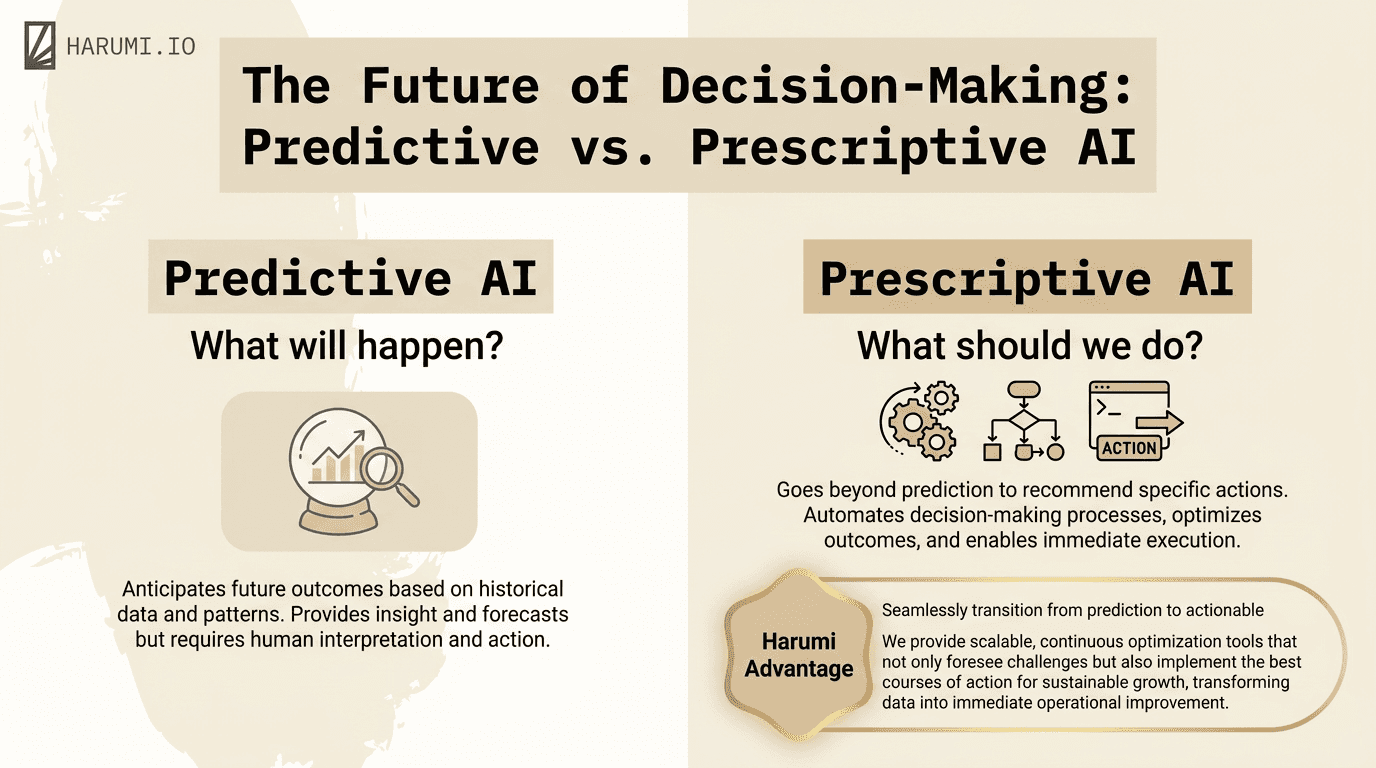
Understanding the boundary between "predicting" and "solving" is crucial for ROI:
Predictive AI: Answers "What will happen?". It anticipates that a motor will fail in 4 hours.
Prescriptive AI: This is the core of Harumi.io. It answers "What should we do?". If a machine is predicted to fail, the system instantly recalculates the entire production sequence, reroutes orders to alternative lines, and adjusts delivery deadlines in the ERP automatically.
4. Operations Research (OR): The Mathematical Core of Optimization
While standard AI learns patterns, Operations Research solves complex equations. In a factory with dozens of machines and hundreds of orders, the possible combinations exceed the number of stars in the galaxy.
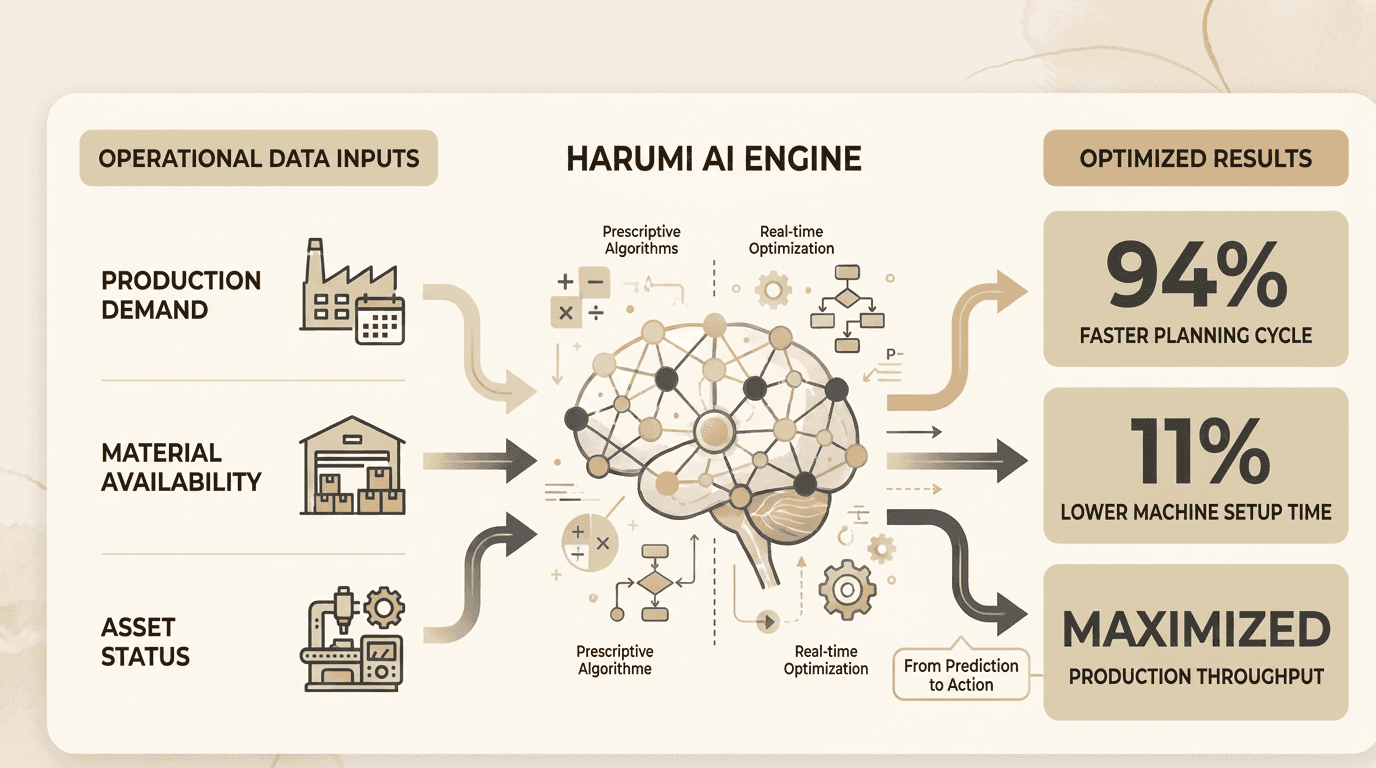
We utilize Linear Programming and Combinatorial Optimization models to solve the "Scheduling Problem." This approach ensures that the output isn't just a suggestion, but the mathematically optimal decision, enabling 94% faster planning.
5. Next-Gen KPIs: Impacting OEE, Lead Time, and Throughput
How does industrial AI move the needle on your P&L?
OEE (Overall Equipment Effectiveness): AI targets the "six big losses," optimizing availability and speed.
Setup Time: Through prescriptive algorithms, we minimize tool changes, often resulting in an 11% boost in productive capacity.
Throughput: We maximize finished goods output without requiring new hardware investments (CAPEX).
6. Implementation Challenges and Digital Maturity
The path to an autonomous factory requires breaking down information silos—where maintenance data doesn't talk to production planning (PCP). The Harumi.io implementation journey focuses on integrating these silos, turning raw data into decisions that drive profit.
7. Strategic FAQ
Does industrial AI replace the Production Planning (PCP) manager? No. It acts as a high-precision GPS, removing the manual calculation burden and allowing the manager to focus on strategy and talent management.
What is the typical ROI timeframe? With Harumi.io solutions, return on investment is generally observed within 6 to 12 months through reduced inventory, eliminated unnecessary overtime, and increased nominal capacity.




" height="39.77198px" id="BKLRi9ayM" transform="translate(2 3.808)" width="44px"/></svg>)